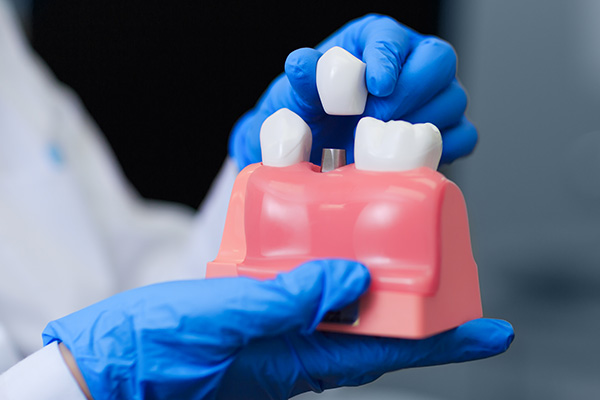
 There are several dental implant options for replacing missing teeth. A dental implant permanently replaces a missing tooth, saving smiles and helping people eat their favorite foods for years to come. Unlike other options for replacing missing teeth, dental implants do not require regular check-ups from a dentist.
The three most common types of dental implants include:
- Endosteal implants
- Subperiosteal implants
- All-on-4 implants®
While all of these implants replace missing teeth, each implant is slightly different. A professional dentist should be consulted to help choose the implant that best fits each person’s needs.
Endosteal implants
An endosteal implant consists of two parts: a small titanium screw and an artificial tooth. The titanium screw is implanted into the jawbone to act as a replacement root. The artificial tooth is attached to the top of the screw. Compared to other dental implants, endosteal implants are the most stable. Endosteal implants also require the longest treatment time because the titanium screw must fuse to the jawbone before the artificial tooth is attached.
Endosteal implants are the most common type of dental implant. However, since the implant is screwed into the jawbone, adequate jawbone density is required to receive an endosteal implant.
Subperiosteal implants
For people that do not have sufficient jawbone density or don’t want an implant in their bone, subperiosteal implants are another option for replacing missing teeth. Unlike endosteal implants, subperiosteal implants are inserted into the gum tissue and placed on top of the jawbone. Subperiosteal implants consist of a metal frame that is implanted in the gum tissue. This frame has posts where artificial teeth are attached. Because the metal frame is not implanted into the jawbone, subperiosteal implants are less stable than endosteal implants but are a suitable dental implant option for people with low jawbone density.
All-on-4 implants
Both endosteal implants and subperiosteal implants are suitable options for people who have lost only a few teeth. If a person has lost an entire row of teeth due to gum disease, All-on-4 implants may be a more fitting option for replacing missing teeth. To attach an All-on-4 implant, a professional dentist will implant four titanium screws into a person’s jawbone. Unlike an endosteal implant, in which only one artificial tooth is attached to each screw, in All-on-4 implants, a full set of artificial teeth is attached on top of the screws. Thus, All-on-4 implants replace more teeth at a time compared to endosteal implants and subperiosteal implants.
Choosing the right dental implant
Having missing teeth may negatively affect a person’s dental health and self-esteem. Luckily, there are several dental implant options for replacing missing teeth. People with sufficient jawbone density will benefit from an endosteal implant. Those with less jawbone density can receive a subperiosteal implant. Those that need to replace an entire set of teeth should consider an All-on-4 implant. Nevertheless, a professional dentist should be consulted to help choose the right dental implant for each person.
Related Posts
A dental bridge is an option for replacing missing teeth that creates a literal bridge from one remaining permanent tooth to the next. Traditionally, these bridges consist of a false tooth, or pontic, connected to a crown placed upon adjacent teeth on either side, although similar, but modified types of bridges do exist.There are multiple…
While people cannot always prevent losing a tooth, there are multiple options for replacing missing teeth. Whether tooth loss is caused by gum disease, an accident, or a genetic condition, it can harm your physical well-being as well as your mental health. It’s common to feel self-conscious if you have a noticeably missing tooth, and…
Within the past few decades, advances in dentistry have resulted in many options for replacing missing teeth. While all of these options help restore functionality and appearance to a person’s mouth, they also differ in several ways. Depending on a patient’s dental history and lifestyle, one replacement option may be better suited for them than…